
About Indonesian
Rare Orchids
Indonesia stands among the world's most remarkable centres of orchid biodiversity. From the cloud forests of Papua to the volcanic slopes of Java, the archipelago harbours thousands of orchid species — and among them, a precious cohort of rare and endemic taxa found nowhere else on Earth.
Orchids (family Orchidaceae) represent the largest family of flowering plants, with over 28,000 recognised species globally. Indonesia's extraordinary geographic and climatic diversity — spanning 17,000 islands across three time zones — has generated a dazzling array of endemic orchid lineages. Species in genera such as Paphiopedilum, Bulbophyllum, Phalaenopsis, and Vanda have evolved spectacular floral forms, intricate pollination strategies, and intimate ecological relationships with specific habitats and pollinators that took millions of years to develop.
"An orchid is not merely a flower — it is a covenant between the plant kingdom and its pollinators, a masterpiece of co-evolution that once lost cannot be reconstructed."
— Adapted from orchid conservation literatureThe diversity of orchids in Indonesia is intimately tied to the concept of endemism — species confined to a single island, mountain range, or forest fragment. Phalaenopsis javanica grows only on the volcanic slopes of Java; Phalaenopsis celebensis is known solely from Sulawesi; Vanda minahassae clings to its native Minahasa Peninsula. This extreme localisation, while a testament to evolution's creativity, also renders these species extraordinarily vulnerable to disturbance.
Rare Adaptations
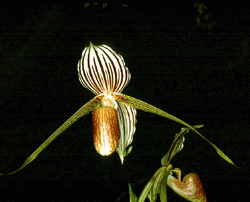
Indonesian orchids display some of the most extraordinary floral architecture in the plant kingdom. Slipper orchids (Paphiopedilum) lure insects into elaborate pouch-like lips; Bulbophyllum nocturnum — the world's only known night-blooming orchid — opens its flowers exclusively after dark. These adaptations represent millions of years of co-evolutionary dialogue between flower and pollinator.
Ecological Importance
Orchids are exquisite indicators of forest health. As epiphytes anchored to tree bark or lithophytes growing on rocky outcrops, they depend on stable, undisturbed habitats. Their root systems harbour mycorrhizal fungi that are essential to the broader forest soil web. The disappearance of an orchid species often signals broader ecosystem degradation, making them valuable sentinel species for conservation monitoring.
Conservation Challenges
Despite their protected status under Indonesian law, rare orchids face overlapping threats: illegal collection for the horticultural and cut-flower trade continues to devastate wild populations; deforestation eliminates entire habitats; agricultural expansion fragments forest corridors; and climate change alters the temperature and humidity regimes on which cloud-forest species depend. Several Indonesian Paphiopedilum species are known from fewer than ten wild populations. The tension between their extraordinary beauty — which drives demand — and their biological fragility creates a conservation paradox that demands urgent, coordinated response.
The Indonesian Ministry of Environment and Forestry (KLHK) classifies all listed rare orchid species as protected organisms under Government Regulation No. 7 of 1999 (PP 7/1999). Collection, trade, or possession without authorisation is subject to significant legal penalties. Yet enforcement varies enormously across the sprawling archipelago, and the internet has opened new channels for illegal trade that outpace regulatory capacity.
Government Regulation No. 7 of 1999 on the Preservation of Plants and Animals designates all listed orchid species as protected flora. Under this regulation, collection, possession, transportation, or trade without authorisation carries significant legal penalties. All Indonesian Paphiopedilum are additionally listed on CITES Appendix I — the highest level of international trade restriction — while most other rare Indonesian orchids fall under CITES Appendix II. These designations reflect global recognition of their threatened status.
This archive documents 29 of Indonesia's rarest and most significant orchid species with scientific rigour and the reverence they deserve — drawing on IUCN Red List assessments, Kew Gardens monographs, the Orchid Species Database, and primary taxonomic literature. It is intended as a living conservation document, growing as new field observations emerge and taxonomic understanding evolves.
All 29 Rare Orchid
Species
A comprehensive archive of Indonesia's protected and endemic orchid species — searchable, filterable, and expandable with detailed ecological and conservation data.
Habitat &
Distribution
Indonesia's rare orchid diversity is not uniformly distributed. Each island chain has produced its own evolutionary experiments, shaped by geological history, climate, and the particular forest types that developed over millennia.
The distribution of rare orchids across the Indonesian archipelago reflects the complex interplay of geological history and ecological opportunity. Slipper orchids (Paphiopedilum) favour montane limestone and ultramafic substrates where competition from other plants is reduced; Phalaenopsis species colonise epiphytic niches in lowland and montane rainforests; Bulbophyllum thrive across a wide range of tropical forest types; and Vanda species tend toward open, well-lit forest margins and forest edges.
The Barisan mountain chain and its vast lowland forests support several endemic Phalaenopsis and Bulbophyllum. P. sumatrana is among the most distinctive, with its striped petals adapted to the diffuse light of the lowland forest interior.
Despite extreme deforestation, Java retains several endemic orchid treasures including Paphiopedilum javanicum and Phalaenopsis javanica — both confined to isolated forest fragments on the volcanic mountain slopes.
Borneo's vast rainforests harbour multiple Paphiopedilum and Bulbophyllum species, including the giant P. kolopakingii and the extraordinary Bulbophyllum nocturnum, the world's only documented nocturnal-blooming orchid.
Sulawesi's complex geology and ancient biogeographic isolation have produced distinctive endemic species including Phalaenopsis celebensis and Vanda minahassae, neither found anywhere else on Earth.
The least explored orchid territory in Indonesia, Papua shelters extraordinary diversity in its highland moors and lowland rainforests. Phalaenopsis gigantea, the world's largest Phalaenopsis, reaches its range limit here.
Climate change poses an acute threat to montane orchid species. As temperature and rainfall patterns shift, the precise humidity and light conditions on which cloud-forest epiphytes depend are altered. Species such as Paphiopedilum rothschildianum — confined to a single mountain in Borneo — face existential risk from even modest habitat disruption. Meanwhile, in lowland habitats, accelerating deforestation continues to eliminate entire orchid communities before they can be scientifically documented.
Conservation
Status Overview
The IUCN Red List provides the global standard for conservation assessment. Among Indonesia's 29 rare orchid species documented in this archive, threat levels span from Critically Endangered to Data Deficient — a spectrum reflecting both extraordinary natural beauty and alarming vulnerability.
Primary Threats
-
🌺
Illegal CollectionThe horticultural trade and cut-flower market create powerful economic incentives for illegal wild collection. Paphiopedilum slipper orchids command exceptionally high prices among collectors worldwide. Despite CITES Appendix I protection, enforcement at the point of collection — often in remote mountain forests — remains deeply inconsistent.
-
🌳
Deforestation & Habitat LossConversion of tropical forests to oil palm, timber plantations, and smallholder agriculture directly eliminates orchid habitat. As epiphytes and lithophytes, rare orchids cannot simply relocate when their host trees are felled. Lowland Phalaenopsis species have suffered especially severe losses as Sumatran and Bornean lowland forests have been cleared.
-
🌾
Agricultural ExpansionUpslope expansion of agriculture into montane zones fragments the cloud forest habitats on which many Paphiopedilum species depend. Even partial clearing can fatally disrupt the microclimatic conditions — humidity, shade, and substrate chemistry — that these highly specialised orchids require.
-
🌡️
Climate ChangeShifting temperature and rainfall patterns alter the precise conditions on which orchid-mycorrhizal partnerships depend. As cloud belts rise with warming temperatures, high-altitude epiphytes face shrinking habitat. Changes in flowering phenology may also disrupt synchrony with specialist pollinators.
-
⛏️
Mining ActivitiesNickel, coal, and gold mining operations in Sulawesi, Kalimantan, and Papua directly destroy orchid habitat on ultramafic substrates and in forested watersheds. Road construction associated with mining opens previously inaccessible forest to collectors and settlers.
Ecological
Importance
Indonesia's rare orchids are far more than horticultural treasures. They play measurable, sometimes irreplaceable roles in tropical forest ecosystems — as biodiversity indicators, pollinator support systems, and participants in complex mycorrhizal networks.
Pollinator Relationships
Indonesian orchids have evolved an astonishing diversity of pollination strategies. Many Paphiopedilum deceive insect pollinators with false nectar signals; Vanda species attract specific bee species; and Bulbophyllum mimic the smell of rotting flesh to attract carrion flies. These intricate co-evolutionary relationships sustain pollinator populations and forest reproduction cycles.
Forest Biodiversity Indicators
Rare orchids serve as precise indicators of old-growth forest condition. As highly sensitive epiphytes requiring stable humidity, air quality, and host-tree associations, their presence signals intact, undisturbed forest ecosystems. Their decline is among the earliest and most reliable signals of forest degradation — making them invaluable ecological sentinels.
Ecosystem Balance
By attracting specific pollinators and engaging in mycorrhizal partnerships, rare orchids contribute to the web of relationships that sustains tropical forest ecosystems. Their loss cascades through food webs: pollinators dependent on orchid floral resources may decline, affecting the reproduction of other plant species and the animals that depend on them.
Orchid-Mycorrhizal Fungi Symbiosis
Every orchid seed — among the smallest in the plant kingdom, containing virtually no nutritional reserves — germinates only in the presence of specific mycorrhizal fungi. These fungal partners penetrate the orchid's root cells and provide the sugars and minerals the seedling needs to survive its early weeks. This dependency continues throughout the orchid's life, anchoring it to a specific soil microbiome. The loss of the appropriate fungal partner through soil disturbance or chemical contamination can render a site unsuitable for orchid regeneration even if the physical habitat appears intact — a hidden threat that makes orchid conservation far more complex than simply protecting the plant itself.
Botanical
Image Gallery
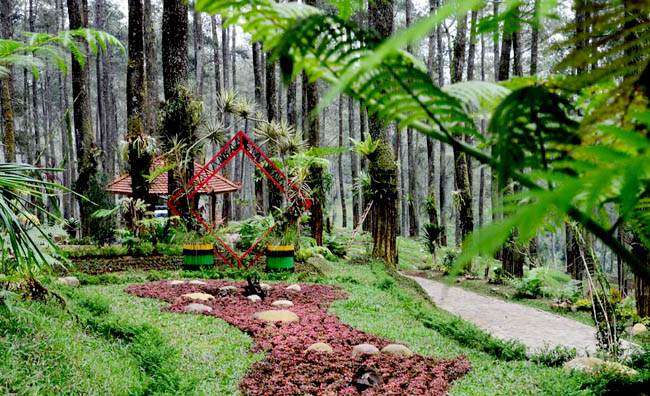
A visual survey of Indonesia's rare orchid diversity — from the pouch-like elegance of slipper orchids to the moonlit blooms of the world's only nocturnal orchid.



References &
Further Reading
This archive draws on primary scientific literature, international conservation databases, and Indonesian government documentation. All species data should be verified against current IUCN assessments.
- IUCN Red List of Threatened Species — Paphiopedilum, Phalaenopsis, Bulbophyllum, and Vanda assessments (various years). International Union for Conservation of Nature. iucnredlist.org
- Kew Gardens — Plants of the World Online — Taxonomic backbone and distribution data for Orchidaceae. powo.science.kew.org
- Orchid Species Database — Comprehensive species profiles and synonymy for all orchid genera. orchidspecies.com
- Indonesian Ministry of Environment and Forestry (KLHK) — Government Regulation No. 7 of 1999 on the Preservation of Plants and Animals (PP 7/1999). Jakarta: Kementerian Lingkungan Hidup dan Kehutanan.
- Botanical Gardens Conservation International (BGCI) — Global orchid conservation strategy and Indonesian partner programme. bgci.org
- CITES Appendix I & II — Convention on International Trade in Endangered Species: Paphiopedilum spp. (Appendix I) and Orchidaceae (Appendix II) listings. cites.org
- Cribb, P.J. (1998) — The Genus Paphiopedilum. 2nd ed. Natural History Publications, Kota Kinabalu & Royal Botanic Gardens, Kew.
- Comber, J.B. (1990) — Orchids of Java. Royal Botanic Gardens, Kew. Bentham-Moxon Trust, Kew.
- Comber, J.B. (2001) — Orchids of Sumatra. Royal Botanic Gardens, Kew.
- Chase, M.W. et al. (2015) — An updated classification of Orchidaceae. Botanical Journal of the Linnean Society 177: 151–174.
- GBIF — Global Biodiversity Information Facility — Occurrence records and specimen data for Indonesian orchids. gbif.org