About Indonesian
Pitcher Plants
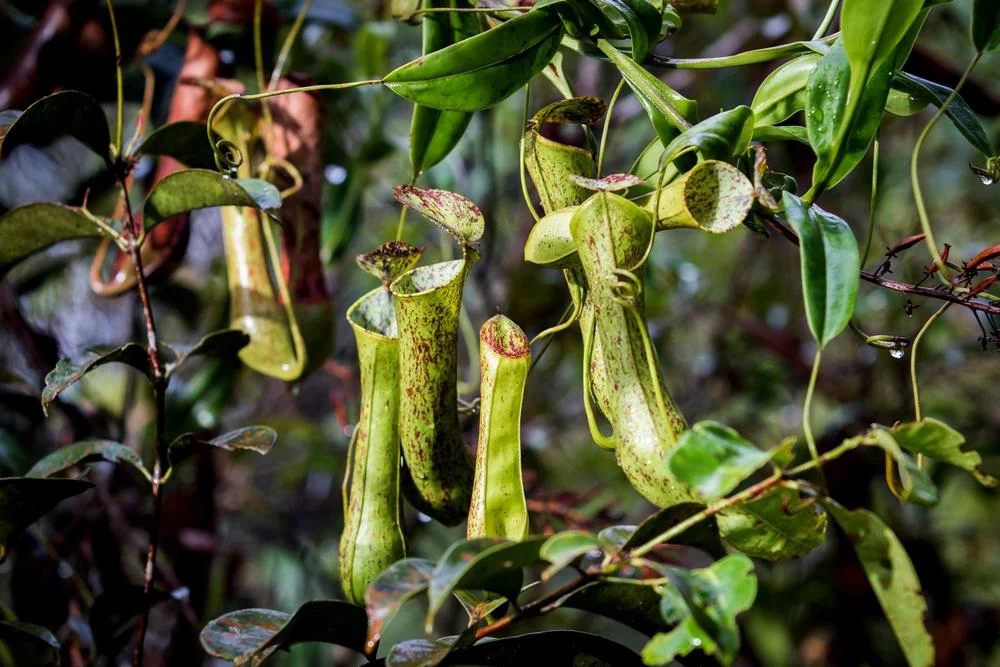
Among the most astonishing expressions of evolutionary ingenuity on Earth, Indonesia's Nepenthes — commonly called Kantong Semar, or pitcher plants — are carnivorous vascular plants that have transformed their leaves into elaborate trapping vessels over millions of years.
Nepenthes belong to the monotypic family Nepenthaceae and represent one of the most dramatic examples of convergent evolution in the plant kingdom. These climbing or scrambling plants anchor themselves in nutrient-poor soils — from coastal peat swamps to cloud-shrouded montane ridges — where photosynthesis alone cannot supply adequate nitrogen and phosphorus. To survive, evolution armed them with pitchers: modified leaf tips that secrete digestive enzymes and collect rainwater, creating a lethal brew for insects, spiders, and occasionally small vertebrates.
"The pitcher is not merely a trap — it is an entire ecosystem in miniature, housing specialised bacteria, larvae, and organisms found nowhere else on Earth."
— Adapted from Nepenthes research literatureThe genus spans tropical Asia, Australasia, and the Seychelles, but its true heartland is the Malay Archipelago. Indonesia, with its vast mosaic of island ecosystems — from the peat forests of Sumatra and Borneo to the highland moors of Papua — hosts the greatest diversity of Nepenthes on the planet. Of the approximately 160 recognised species globally, Indonesia claims roughly 59 species under national legal protection, many of which are endemic to a single island, mountain range, or river valley.
Carnivorous Adaptations
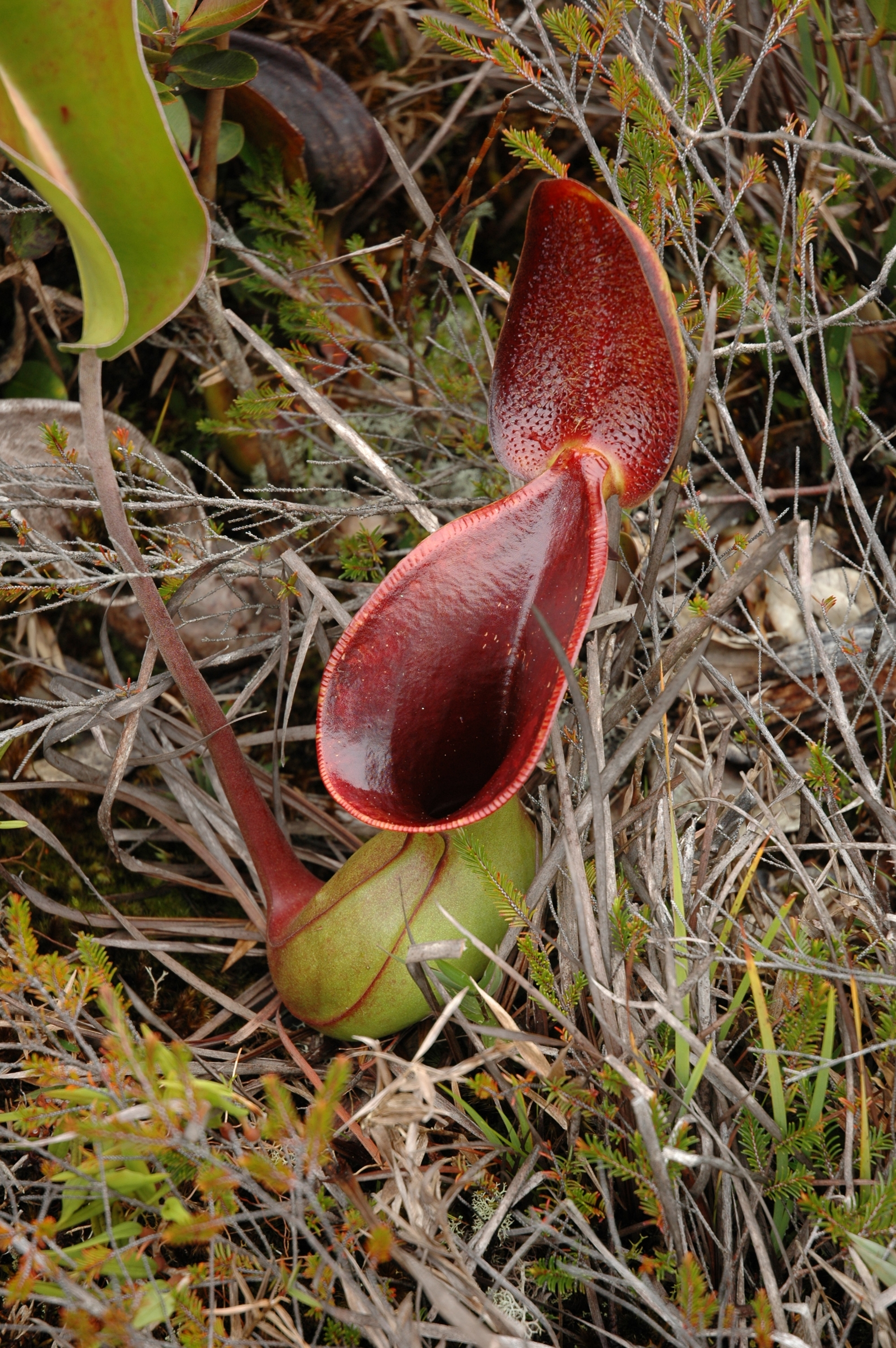
The pitcher — technically an ascidium — develops from a tendril extension of the leaf midrib. Its inner walls are slippery and waxy, its rim (the peristome) ridged to trap insects; glands lining the interior secrete proteases that dissolve prey in hours. Upper pitchers often differ dramatically from lower ones on the same plant, adapted for aerial prey rather than ground-crawling fauna.
Ecological Importance
Far from passive death-traps, pitcher plants are keystone micro-habitats. The pitcher fluid supports entire food webs of specialised organisms — Nepenthes-exclusive mosquito larvae (Toxorhynchites), crab spiders, tree shrews, and even carnivorous plants within carnivorous plants. Their nitrogen recycling reduces pressure on already depleted forest soils.
Conservation Challenges
Despite their protected status under Government Regulation No. 7 of 1999 (PP 7/1999), Indonesian Nepenthes face mounting pressures: habitat loss from palm oil expansion, illegal collection for the horticultural trade, climate-driven shifts in cloud forest hydrology, and the compounding effects of fire on peat ecosystems. Several species are known from fewer than five populations, some from a single mountain. Indonesia's extraordinary endemism is simultaneously its greatest conservation crisis.
The Indonesian Ministry of Environment and Forestry (KLHK) classifies all 59 listed Nepenthes as protected organisms — it is illegal to collect, trade, or destroy them without special research permits. Yet enforcement remains inconsistent across the archipelago's 17,000 islands. International support, local community stewardship, and scientific documentation are the three pillars on which their survival depends.
Government Regulation No. 7 of 1999 on the Preservation of Plants and Animals designates all listed Nepenthes species as protected flora. Under this regulation, collection, possession, transportation, or trade without authorisation carries significant legal penalties. The regulation represents Indonesia's commitment to the Convention on Biological Diversity and CITES Appendix II listings for the genus.
This archive documents all 59 protected species with scientific rigour and the reverence they deserve — drawing on IUCN assessments, Kew Gardens monographs, GBIF occurrence data, and primary taxonomic literature. It is a living document, intended to grow as new field observations emerge and taxonomic understanding evolves.
All 59 Protected
Nepenthes Species
A comprehensive record of every Nepenthes species under Indonesian legal protection — searchable, filterable, and expandable with detailed ecological and conservation data.
Habitat &
Distribution
Indonesia's Nepenthes diversity is not evenly spread — it mirrors the archipelago's geological complexity, each island chain producing its own evolutionary experiments in carnivorous botany.
The primary driver of Nepenthes distribution in Indonesia is substrate: these plants almost universally favour nutrient-poor, acidic soils — peat swamps, kerangas (heath forest) soils, ultramafic outcrops, and the thin organic layers of montane ridges. These conditions, hostile to most plants, represent refuges from competition where Nepenthes thrive.
The Barisan Mountains form the spine of Sumatran Nepenthes diversity. Species range from coastal peat-swamp forms to cloud forest specialists above 3,000m on Kerinci and Sinabung.
Borneo's vast peat swamp forests and the Meratus and Müller ranges host iconic species including N. bicalcarata — the only species known to have a mutualistic relationship with ants.
Sulawesi's complex geology — a collision of Gondwanan and Asian terranes — produces unusual ultramafic substrates that support highly endemic Nepenthes communities.
The least explored region, Papua harbours some of the largest-pitcher species known. The highland moors of the Central Range exceed 3,000m and remain poorly surveyed.
Most heavily deforested of Indonesia's major islands, Java retains Nepenthes only in isolated montane pockets. N. adrianii and N. gymnamphora persist on Dieng and Lawu.
Climate change poses a particularly acute threat to montane species. As cloud layers rise with warming temperatures, the narrow band of cloud forest on which high-altitude Nepenthes depend literally shrinks upward. Species already confined to mountain summits — like N. villosa on Kinabalu and Tambuyukon — face the spectre of range contraction with nowhere left to go.
Conservation
Status Overview
The IUCN Red List provides the global standard for conservation assessment. Among Indonesia's 59 protected Nepenthes, threat levels span from Critically Endangered to Least Concern — a spectrum reflecting both the richness and the vulnerability of the genus.
Primary Threats
-
🌳
Deforestation & Habitat LossConversion of tropical forests to oil palm plantations, rubber estates, and smallholder agriculture remains the single greatest driver of Nepenthes decline. Sumatra has lost over 50% of its lowland forest since 1985.
-
🔥
Peat Fire & DrainageAnnual burning of peat swamps — whether for land clearance or through escaped fires — destroys the specialised substrate on which lowland species like N. ampullaria and N. bicalcarata depend. Drainage canals dry out peat, making fires more severe.
-
🪴
Illegal Collection & TradeThe global carnivorous plant trade creates demand for rare Nepenthes. Wild-collected plants of species like N. hamata, N. villosa, and N. clipeata command high prices. Despite CITES Appendix II listing, enforcement remains inconsistent at the species level.
-
🌡️
Climate ChangeRising temperatures are shifting cloud belts upward, compressing montane habitat. Species restricted to summit ridges face functional extinction within decades if projections hold. Changes in precipitation patterns also affect pitcher fluid chemistry and prey availability.
-
⛏️
Mining & InfrastructureUltramafic-substrate specialists in Sulawesi and Kalimantan face direct destruction from nickel mining operations. Road construction opens previously inaccessible forest to collectors and settlers.
Ecological
Importance
Nepenthes are far more than botanical curiosities. They play measurable, sometimes irreplaceable, roles in tropical forest ecosystems — roles that disappear with their extinction.
Nutrient Cycling
In nitrogen-depleted soils, Nepenthes intercept and mineralise organic nitrogen from prey, releasing it into the rooting zone. This local nutrient enrichment supports neighbouring plants and soil microbiomes in kerangas and peat environments.
Insect Population Control
Large-pitcher species can consume thousands of insects annually. While their effect on mosquito populations is debated, they do reduce local densities of specific dipteran and hymenopteran species — an ecosystem service with indirect public health implications.
Biodiversity Support
The pitcher fluid microbiome — a community of bacteria, protozoa, rotifers, and insect larvae — constitutes a discrete aquatic ecosystem. Several organisms are entirely dependent on Nepenthes pitchers and would go extinct if their host plant disappears.
Soil Stabilisation
As pioneer plants on disturbed, nutrient-poor soils, Nepenthes contribute to slope stabilisation and early successional forest recovery, particularly on ultramafic substrates where few other plant species can establish.
Vertebrate Mutualism
Tree shrews (Tupaia spp.) feed on nectar secreted by the pitcher lid and defecate into the pitcher, contributing significant nitrogen. Woolly bats roost inside pitchers of N. lowii, similarly contributing droppings. These interactions are among the most specialised plant-vertebrate mutualisms known.
Pharmacological Potential
Pitcher fluid enzymes — nepenthesins I and II — are novel aspartic proteases with potential biotechnological applications. Traditional uses in bordering communities include the sterile pitcher fluid as an eye wash. The biochemical frontier of Nepenthes research is largely unexplored.
The Ant Mutualism of Nepenthes bicalcarata
Nepenthes bicalcarata — the fanged pitcher plant of Bornean peat swamps — engages in one of the most extraordinary plant-animal mutualisms documented. The hollow, swollen tendrils of the plant serve as a nest site for Camponotus schmitzi, an ant species found nowhere else. These ants clean the pitcher rim, prevent the plant from becoming clogged with large prey, and patrol against herbivores. In exchange, the plant provides shelter and nutrients. Studies show that plants without their ant colony grow significantly smaller — the mutualism is not optional but near-obligate for optimal plant fitness.
Botanical
Image Gallery
A visual survey of Nepenthes diversity — from the crystalline depths of pitcher fluid to the mossy ridgelines where ancient species cling to survival.


References &
Further Reading
This archive draws on primary scientific literature, international conservation databases, and Indonesian government documentation. All species data should be verified against current IUCN assessments.
- IUCN Red List of Threatened Species — Nepenthes assessments (various years). International Union for Conservation of Nature. iucnredlist.org
- Kew Gardens — Plants of the World Online — Taxonomic backbone and distribution data for Nepenthaceae. powo.science.kew.org
- GBIF — Global Biodiversity Information Facility — Occurrence records and specimen data. gbif.org
- Indonesian Ministry of Environment and Forestry (KLHK) — Government Regulation No. 7 of 1999 on the Preservation of Plants and Animals (PP 7/1999). Jakarta: Kementerian Lingkungan Hidup dan Kehutanan.
- Clarke, C.M. (1997) — Nepenthes of Borneo. Natural History Publications, Kota Kinabalu.
- Clarke, C.M. & Lee, C.C. (2004) — Pitcher Plants of Sarawak. Natural History Publications, Kota Kinabalu.
- Jebb, M.H.P. & Cheek, M. (1997) — A skeletal revision of Nepenthes. Blumea 42: 1–106. Rijksherbarium, Leiden.
- McPherson, S.R. (2009) — Pitcher Plants of the Old World. 2 vols. Redfern Natural History Productions, Poole.
- Barthlott, W., Porembski, S., Seine, R. & Theisen, I. (2007) — The Curious World of Carnivorous Plants. Timber Press, Portland.
- Chin, L., Moran, J.A. & Clarke, C. (2010) — Trap geometry in three giant montane pitcher plant species from Borneo is a function of tree shrew use. New Phytologist 186: 461–470.
- CITES Appendix II — Convention on International Trade in Endangered Species: Nepenthes spp. listing. cites.org